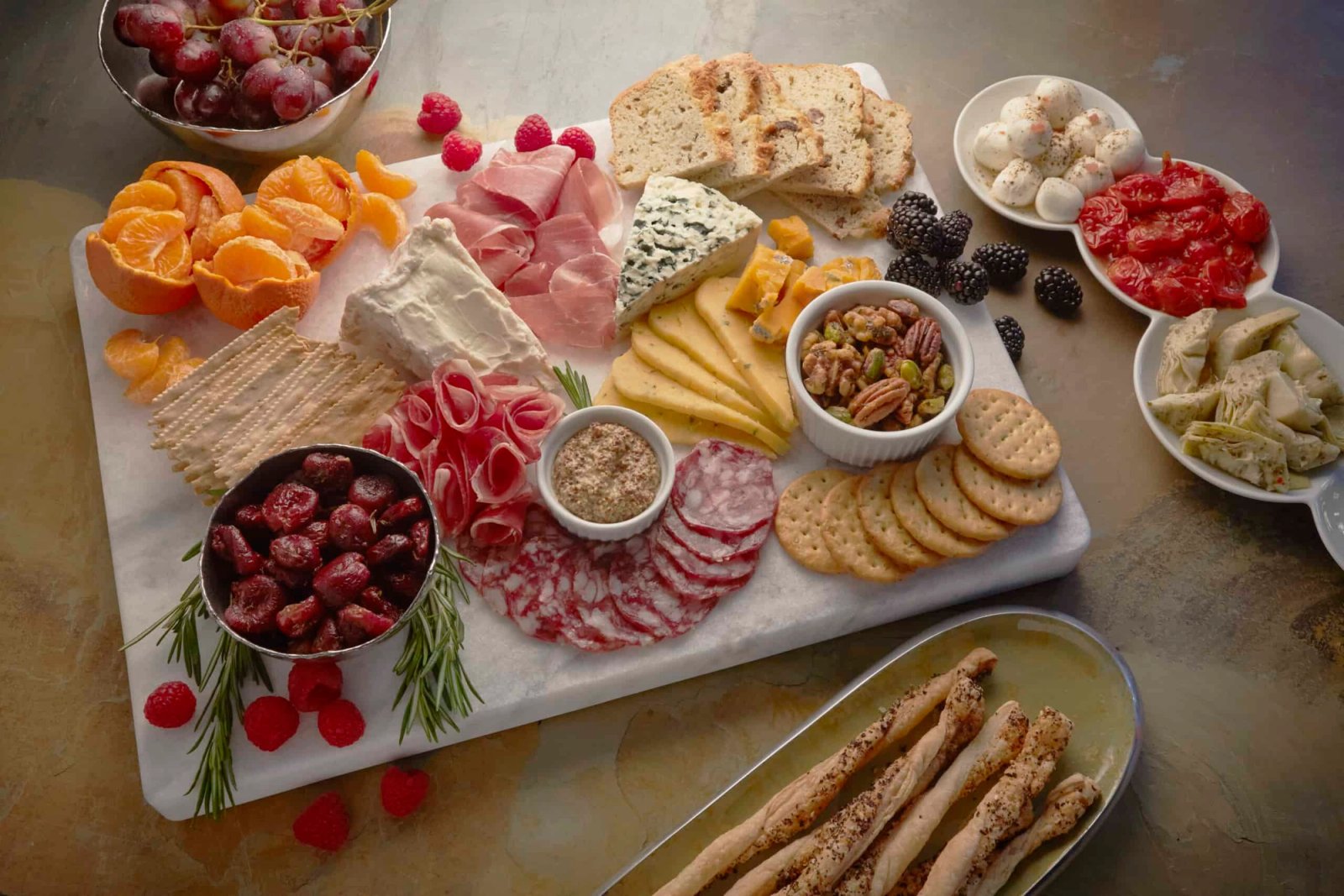
Charcuterie Board
© Chef Laura Bonicelli
Creamy Délice de Bourgogne meets sharp aged cheddar and peppery blue cheese, crowned with sweet roasted grapes that burst with rosemary fragrance. My go-to spread for lazy weekend afternoons or when friends drop by unexpectedly — pure indulgence on a board.
Prep Time
45 min
Cook Time
—
Total Time
45 min
Servings
12 servings
Ingredients
cheeses 6 - 8 ounces each
- Délice de Bourgogne or Saint-André --, triple cream whole wedge
- blue cheese -- whole wedge, broken - halved
- Cotswald -- sliced
- Manchego or aged Cheddar -- broken into pieces
- small mozarrella balls, ricotta, or burrata -- ramekin
accompaniments in ramekins or dishes
- roasted rosemary grapes
- grainy mustard
- roasted tomatoes
- fig or berry spread
- rosemary nuts
Meats-2 to 8 ounces each
- proscuitto -- torn
- coppa salami -- sliced
- Genoa salami -- sliced
- soppresata -- sliced
pickled items
- cornichons
- pickled peppers
- pickled artichokes
nuts and fruits=====your choice -- I only use fruits that brown in the air if I know the platter will be eaten right away
- shelled pistachios
- almonds or pecans
- clementines -- torn in half with sections free
- raspberries
- blackberries
- pomogranates
- fresh herbs for garnish
Instructions
- 1
Assemble all ingredients, serving ware, and utensils.
- 2
Put accompaniment items in appropriately-sized bowls or ramekins. (You may have some things that you want to serve in dishes off of the board.)
- 3
Put your main charcuterie board on a table.
- 4
Place an entire torn-fruit item, like clementines or torn-open pomegranates, in a corner of the board..
- 5
Add the whole soft cheeses. (Generally, I use the softer ones that easily spread with a knife - I don't want any actual cutting on the board.)
- 6
Arrange your ramekin items on the board. Placing items close to things they naturally go with. (For example, I put the roasted rosemary grapes by the Délice.)
- 7
Arrange the meats around the cheeses and accompaniments by stacking, folding them into flowers, and fanning.
- 8
Arrange the sliced or torn hard cheeses on the board.
- 9
Fill in the spaces with assorted crackers by stacking, fanning, and standing on end.
- 10
Finally, randomly add berries and other nuts, if using.
- 11
You can stack some of the toothpicks and serving items on the board or arrange them in a dish on the side.
- 12
Garnish with herbs.
Nutrition Facts
Per Serving (serves 12 servings)
* Nutritional information is estimated and may vary based on specific ingredients and preparation methods.
Chef's Notes
Charcuterie, which dates back to 15th century France, used to refer to a plate of cured meats. Today, though, the charcuterie board has evolved to include cheeses, condiments, bread, crackers, fruits, vegetables, and more. A beautiful charcuterie board starts with the planning. You have a few decisions to make before you start buying your ingredients. The first one is to decide if you are going to focus on a theme. You can use products produced in a particular country, like France, Italy, or Spain. You also could choose to gather local cheese and meats; it has become much easier to use local meats and cheeses with so many small producers making wonderful products. Whether I follow a theme or not, I always select a variety of meats and cheeses. I always like to have a couple of cheeses that are soft, one or two semi-soft, and at least one semi-hard or firm cheese that I can break into pieces. I always try to choose items that complement each other in color, texture, variety, and uniqueness. Next, you must decide on any condiments, fruits, vegetables, etc., that will balance your meats and cheeses. Finally, consider the accompaniments; I usually make some of the bread or crackers myself; I love freshly baked breads and it makes the board more unique. After deciding on the ingredients, you must also decide on what kind of serving dish you want to use - a cutting board, a marble slab, or a shallow platter. There are many beautiful boards made just for charcuterie, but you can also be creative in your choice of the board you will use. You will also need some small dishes for items with juice or sauce. Once you have your products purchased, get the necessary serving dishes together along with toothpicks, cheese knives, small forks, plates, and napkins. You are now ready to place your ingredients on your board. Just a note: I like to do a little research on the producers and the characteristics of the products I choose and put together a little information sheet; people will want to know about what you're serving. I keep extras of the ingredients handy to replenish the board. I always replace cheeses when they start to look depleted.